
What Is a Money Market Account? A Simple Guide to Smarter Saving
September 2026
You know what a checking account is. You probably know how a savings account works. And you may have heard of share certificates, the credit union equivalent of Certificates of Deposit (CDs).
But a money market account?
For many people, that’s where things get a little less clear.
Despite the name, a money market account isn’t an investment account, and you don’t need to be a financial expert to use one. It’s simply another type of savings account that may offer a competitive dividend rate while still giving you access to your money.
If you’re looking for a way to help your savings grow while keeping your money accessible, a money market account could be worth getting to know.
First Things First: What Is a Money Market Account?
A money market account, is a deposit account designed to help you save while keeping your money relatively accessible.
Like a traditional savings account, you deposit money into the account and earn dividends on your balance. Depending on the financial institution and account, money market accounts may offer higher dividend rates, particularly at certain balance levels.
That can make them appealing for people who have accumulated savings they don’t need for everyday expenses but aren’t ready to lock away for an extended period.
Think of it this way:
- Checking is generally for money you plan to spend.
- Savings is for money you want to set aside.
- A money market account can be a place for savings you want to keep accessible while giving it greater potential to grow.
How Does a Money Market Account Work?
The basic concept is straightforward: You deposit money, maintain a balance and earn dividends based on the account’s terms and current rate.
Some money market accounts have minimum balance requirements or tiered rates, meaning the dividend rate you earn may depend on your account balance. Withdrawal and transaction options can also vary by financial institution.
Unlike a share certificate, however, a money market account typically does not require you to commit your money for a predetermined amount of time.
That distinction is important.
You may be saving for something that’s six months away, or something that could happen tomorrow. A money market account can give those funds an opportunity to earn dividends without necessarily sacrificing access to them.
Money Market vs. Savings vs. Share Certificate: What’s the Difference?
All three can play a role in a savings strategy, but they aren’t interchangeable.
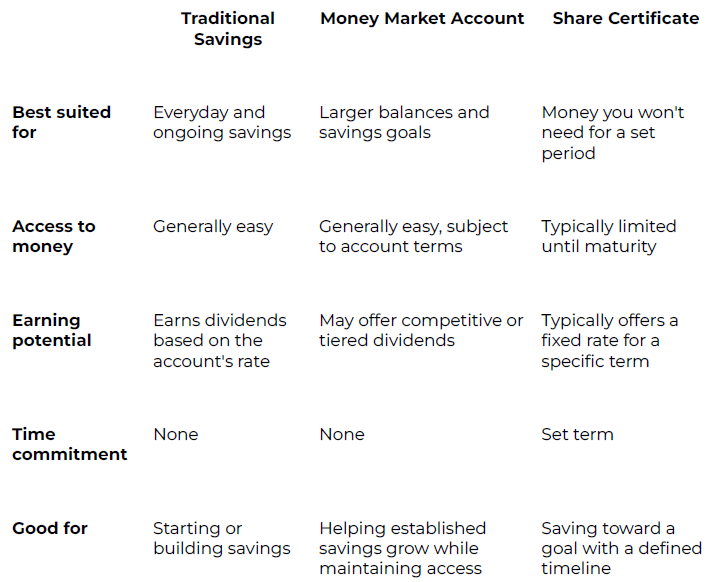
The important thing isn’t deciding which account is universally “best.” It’s deciding which one makes the most sense for what you want your money to do.
When Might a Money Market Account Make Sense?
Consider the money you already have saved.
Maybe you’ve built an emergency fund and want to keep it readily available. Perhaps you’re accumulating a down payment for a home. You might be saving for tuition, a vehicle, home improvements or another large expense.
Or maybe you’ve simply reached the point where a meaningful amount of money is sitting in a general savings account, and you’re wondering whether it could be doing more.
Those are all good reasons to explore a money market account.
It may be particularly useful for:
- Emergency savings. Your money can remain accessible if an unexpected expense arises.
- Short- to medium-term goals. Think home down payments, major purchases, renovations or other planned expenses.
- Larger savings balances. Some accounts offer tiered dividend rates that reward higher balances.
- Money you’re not ready to lock away. You can potentially earn competitive dividends without committing to a share certificate term.
What Should You Look for in a Money Market Account?
Not every money market account works exactly the same way, so don’t compare accounts based on the advertised rate alone.
Take a look at the full picture, including the current dividend rate and APY, minimum opening deposit, minimum balance requirements, balance tiers, potential fees and how easily you can access or transfer your money.
Most importantly, consider whether the account fits the way you intend to save.
A great rate isn’t especially helpful if the account’s requirements don’t align with your balance, timeline or need for access.
Could Your Savings Be Working Harder?
Opening a savings account is an important step, but your savings needs and goals can change over time.
As they do, it can be helpful to periodically review your accounts and make sure they still align with what you’re trying to accomplish.
A traditional savings account may continue to be a great fit, particularly when you’re taking advantage of account features or rewards available to you. For other savings goals, a money market account may offer another option worth considering. And if you have money you’re confident you won’t need for a certain period, a share certificate could also have a place in your savings strategy.
Different accounts offer different benefits, and the right choice depends on your goals, your savings habits and how you plan to use your money. You may even find that more than one type of account makes sense.
That’s part of building a savings strategy: finding the right place for your money based on the job you want it to do.
Money Market Accounts: Frequently Asked Questions
Q: Is a money market account the same as a savings account?
Not exactly. Both are deposit accounts designed for saving, but their rates, balance requirements and other features can differ. Money market accounts may be particularly attractive for larger savings balances.
Q: Is a money market account the same as a money market fund?
No. Despite their similar names, they are different financial products. A money market account is a deposit account offered by a financial institution. A money market fund is an investment product.
Q: Can I withdraw money from a Money Market Account?
Generally, yes. One of the primary differences between a money market account and a share certificate is that an MMA typically allows you to access your money without waiting for a term to end. Specific transaction rules vary by account.
Q: Can I keep adding money to a money market account?
Generally, yes. That can make an MMA useful for savings goals you’re continuing to build over time.
Q: Do money market accounts earn dividends?
Yes. At a credit union, money market accounts can earn dividends based on the account’s rate and terms. Rates may vary or be tiered according to balance.
Q: Who should consider a money market account?
Someone who has accumulated savings, wants the opportunity to earn competitive dividends and still wants convenient access to those funds may find a money market account worth considering.
Find the Right Home for Your Savings
Saving money is important. Knowing where to save it can be just as important.
A traditional savings account, money market account and share certificate can each serve a different purpose. Understanding those differences can help you make more informed decisions as your savings, and your financial goals, grow.
At UCU, we’re here to help you understand your options and choose an approach that makes sense for your goals.
Ready to learn more about money market accounts? Explore UCU’s savings options and see what could work for U.
Questions about UCU Money Market Accounts? Visit our Money Markets page or give us a call at 800.696.8628.